
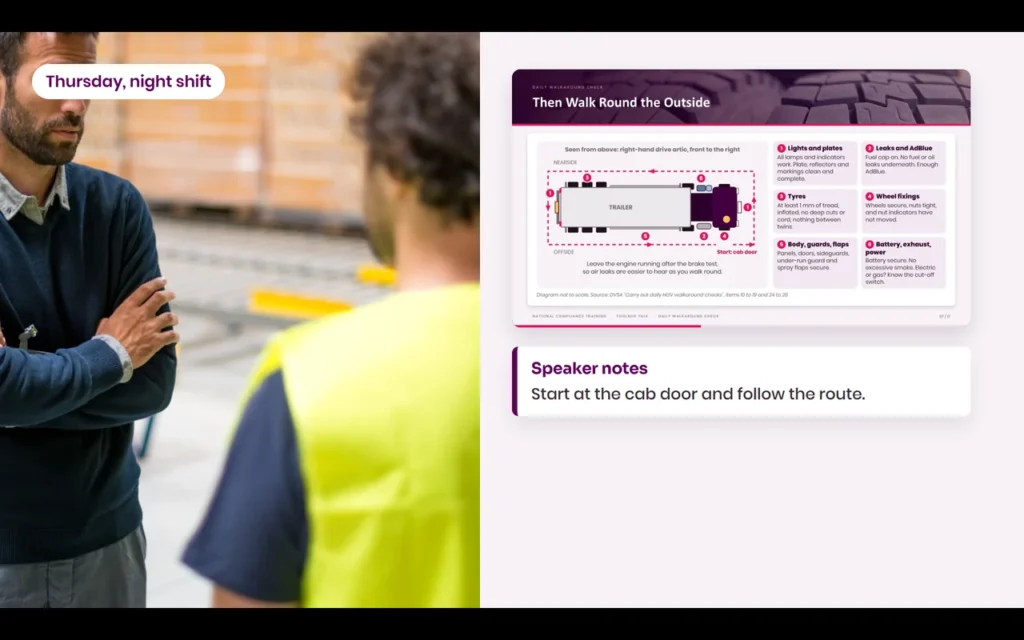
A driver toolbox talk is a short, focused briefing on one subject, delivered to a driver or a group of drivers and recorded. Run regularly, toolbox talks keep drivers up to date with the rules and the risks they face every day, and give operators a dated record that the briefing took place. This guide explains what the law expects, how to run a programme that drivers complete, and which topics to cover through the year.
Toolbox talks, written, narrated and recorded for you
Our Driver Toolbox Talks licence gives you a library of 90 fact-checked, narrated talks. Drivers watch on their phone or in a group, answer five questions and receive a certificate, and you keep the record.
What is a driver toolbox talk?
The name is usually traced to construction sites, where a supervisor would gather the team around the toolbox at the start of the day to talk through a single hazard. In transport the idea is the same: one subject, covered properly, in a few minutes, at a time when drivers can give it their attention.
A good driver toolbox talk explains what the rules require, where the real risks are, and what good practice looks like on the job. It then checks that the key points have landed, usually with a few questions, and records who received it. That last step is what turns a conversation in the yard into evidence.
Toolbox talks can be delivered face to face at the start of a shift, or individually, with each driver watching a talk on their phone. Most operators need both: group sessions for drivers based at the depot, and individual delivery for night drivers, agency drivers and anyone who rarely sees the yard.
Why operators run them
Under section 2 of the Health and Safety at Work etc. Act 1974 (HASWA), every employer must provide the information, instruction, training and supervision needed to keep employees safe at work, so far as is reasonably practicable. For a transport operator, much of that information concerns the vehicle, the load and the road.
Operator licensing adds its own expectations. The GOV.UK operator licensing guide says traffic commissioners look for satisfactory arrangements for securing compliance with drivers’ hours rules, and for operators to ensure drivers have the correct licence and training to drive goods vehicles. When something goes wrong, at a DVSA visit, a public inquiry or an insurance claim, the question is rarely whether the rules were written down. It is whether the drivers were told, and whether you can prove it.
The rules also keep changing. Smart tachographs, the extension of tachograph rules to vans on international work, and London’s Direct Vision Standard have all changed what drivers need to know in recent years. A regular briefing programme is the simplest way to keep a whole fleet current. Our guide to the 2026 tachograph rules for vans is one example of how quickly that picture can move.
Finally, accreditation schemes, customers and insurers increasingly ask operators to show how drivers are kept up to date. A dated record of briefings, with the subject, the version and the result, answers that question in minutes.
Toolbox talks and Driver CPC
Toolbox talks are not Driver CPC periodic training and do not count towards a driver’s 35 hours. Driver CPC periodic training is delivered through approved courses, which count towards the 35 hours a driver must complete every five years. Toolbox talks sit alongside it: short, frequent briefings on the subjects that matter to your operation, between the longer periodic training sessions.
If you also need periodic training, we deliver Driver CPC periodic training as an approved centre.
Never during a break
Drivers must never be asked to complete a toolbox talk during a break or rest period.
Under the assimilated drivers’ hours rules, a break is a period during which a driver may not carry out any driving or any other work, and which is used exclusively for recuperation. A toolbox talk is work. Schedule talks in working time, for example at the start of a shift, and record the time as other work on the tachograph, or as duty time under the GB domestic rules. The same applies when a driver watches a talk on their phone: it belongs in the working day, not in a break.
How to run a programme drivers complete
- Plan the year. Choose a talk for every week or two, and set the seasonal subjects against the months they matter most. A plan agreed in advance is far easier to keep to than choosing a topic each Monday morning.
- Keep each talk short and focused. One subject, around ten minutes. A talk that tries to cover everything is remembered for nothing.
- Deliver it two ways. Run group sessions where drivers start together, and send the same talk to the phones of drivers who do not, so that no one is missed because of their shift pattern.
- Check understanding. A few questions at the end show whether the key points have landed, and give a driver the chance to ask about anything unclear.
- Record every briefing. Who, when, which talk, which version, how it was delivered and the result. Keep the record somewhere you can find it quickly.
- Act on what comes back. Questions, defects and near misses raised during a talk are some of the most useful information you will get. Follow them up and tell drivers what changed.
- Review when the rules change. Retire out-of-date material and brief drivers again when a rule they rely on changes.
What to cover
Start with the subjects that cause the most incidents and the most roadside prohibitions, then widen the programme to the work your drivers do. Our library groups its 90 talks into eight themes:
- Core talks (12 talks)
Covering the subjects every driver needs, from the daily walkaround to what to do after a collision. For example: Drivers' Hours, Coupling and Uncoupling, Fatigue, Getting In and Out of the Cab Safely.
- Vehicles, loads and weights (12 talks)
Covering tyres, brakes, lights, trailers, bridge strikes and keeping within weight limits. For example: Tyres and Wheel Security, Mirrors, Cameras and Sensors, Vehicle Height and Bridge Strikes, Securing Different Load Types.
- Drivers' hours, tachographs and licences (12 talks)
Covering breaks, rest, working time, tachograph cards and entries, roadside checks and the operator licence. For example: Breaks Done Properly, GB Domestic Drivers' Hours, Smart Tachographs, Your Licence, Points and Conduct.
- On the road (12 talks)
Covering reversing, following distances, motorways, junctions, level crossings, rural and urban driving. For example: Reversing Safely, Motorways and Smart Motorways, Overtaking and Being Overtaken, Urban Driving and Deliveries.
- Weather and health (12 talks)
Covering fog, wind, flooding and heat, night driving, medical fitness, eyesight and wellbeing. For example: Fog and Poor Visibility, Hot Weather, Eyesight, Manual Handling for Drivers.
- Site, yard and security (12 talks)
Covering yards, loading bays, tail lifts, working at height, tippers, cranes, fires and load security. For example: Yard Safety and Pedestrians, Tail Lifts, Lorry Loader Cranes, Vehicle and Load Security.
- Professional standards (6 talks)
Covering conduct, proof of delivery, near misses, telematics and starting as a new or agency driver. For example: The Professional Driver, Customer Service and Proof of Delivery, Near Misses and Reporting Hazards, Telematics and Camera Systems.
- Sector packs (12 talks)
Covering construction and CLOCS, vans, bus and coach, dangerous goods, temperature-controlled loads, livestock and waste. For example: Construction Sites and CLOCS, Vans: Checks and Defects, Accessible Transport, Temperature-Controlled Loads.
The full list of talks, by theme, is on the Driver Toolbox Talks page.
A simple year plan
Seasonal subjects land best just before the conditions arrive. One way to spread them across the year, alongside your core subjects:
| Months | Talks to schedule |
|---|---|
| January to March | Winter Driving, Fog and Poor Visibility, High Winds, Flooding and Heavy Rain |
| April to June | Tyres and Wheel Security, Vulnerable Road Users, Reversing Safely, Rural Roads |
| July to September | Hot Weather, Fatigue, Driving Abroad, Diet, Hydration and Staying Well |
| October to December | Night Driving, Lights, Reflectors and Markings, Slips, Trips and Falls in the Yard, Winter Driving |
Fill the remaining weeks with the core talks, the subjects linked to your recent defects and incidents, and anything that has changed in the rules.
Our Driver Toolbox Talks licence
Our Driver Toolbox Talks licence gives HGV operators the whole programme in one place. Every talk is written and fact-checked by our transport compliance team against current DVSA guidance, the Highway Code and the regulations themselves, and reviewed when the rules change.
- On their phone. Assign a talk and each driver receives an email with a link to watch a narrated talk of around eight minutes, answer five questions and receive a certificate.
- With a group. Every talk comes with presenter slides and speaker notes. Tick who attended and add a photo of the signed register.
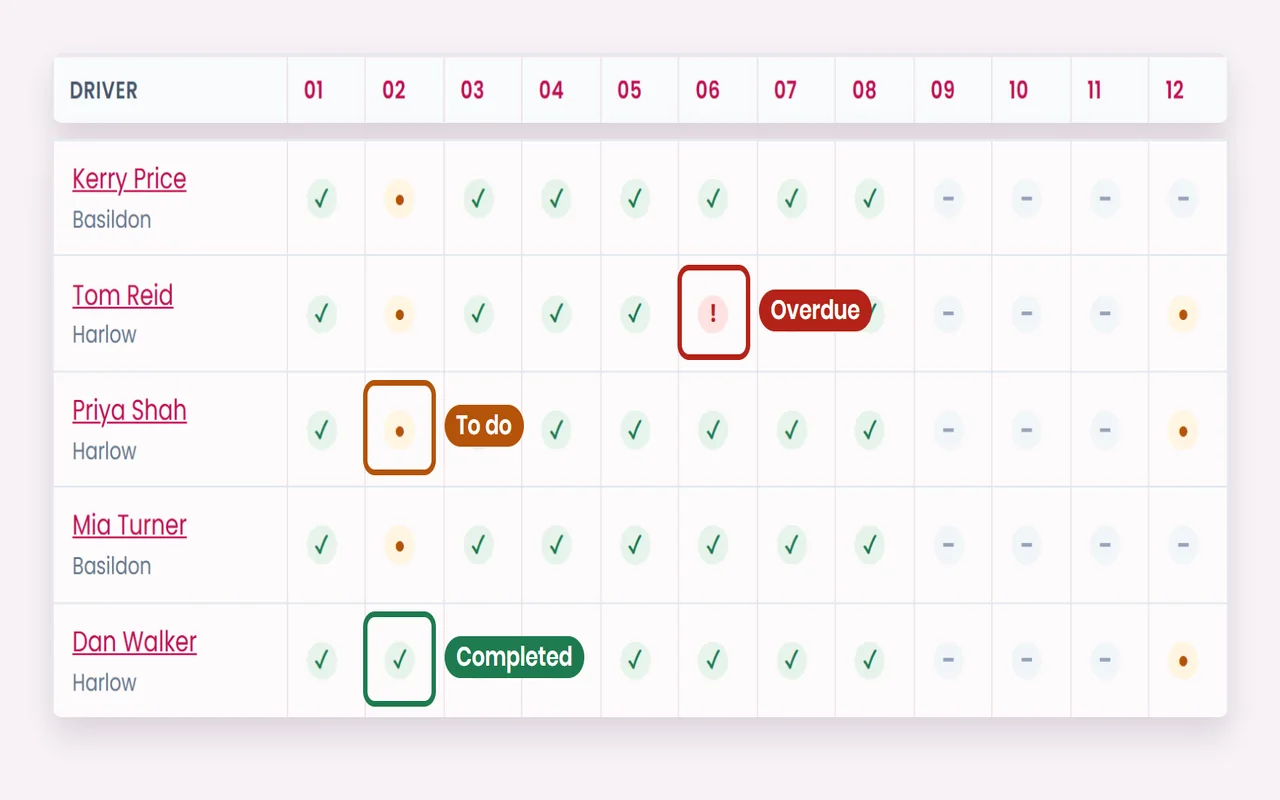
- In one record. A progress grid for the whole fleet, a training record for any driver, and a spreadsheet export of every completion.
| Licence | Price | Per driver |
|---|---|---|
| Up to 5 drivers | £125 + VAT a year | £25.00 per driver |
| Up to 10 drivers | £225 + VAT a year | £22.50 per driver |
| Up to 25 drivers | £450 + VAT a year | £18.00 per driver |
| Up to 50 drivers | £795 + VAT a year | £15.90 per driver |
Every licence covers the full library, including the sector packs, and new talks are added at no extra cost. For more than 50 drivers, call us on 020 3026 4629 for a quote. Use the code TOOLBOX20 at checkout for 20% off the first year of a licence, until 4 February 2027.
See the Driver Toolbox Talks licence →
Frequently asked questions
How long should a toolbox talk be?
Long enough to cover one subject properly and short enough to hold attention: around ten minutes is a good target. Each talk in our library is a narrated video of around eight minutes, followed by five questions.
How often should we run toolbox talks?
Many operators aim for one talk every week or two, so that each driver receives a steady run of briefings across the year. Add a talk whenever something changes: a new rule, a new vehicle type, a near miss or a pattern of defects.
Do agency drivers need toolbox talks?
Yes. Agency drivers drive your vehicles under your operator licence, and they often know least about your vehicles, routes and procedures. Assigning a talk to an agency driver on their phone is a quick way to brief them and keep a record that you did.
Do toolbox talks count towards Driver CPC?
No. Driver CPC periodic training is delivered through approved courses, which count towards the driver's 35 hours. Toolbox talks are short briefings that sit alongside Driver CPC, and our certificates and records say clearly that they are not Driver CPC.
Can drivers complete a toolbox talk during their break?
No. A break must be used only for rest, and a toolbox talk is work. Schedule talks in working time, for example at the start of a shift, and record the time as other work.
What records should we keep?
For each briefing: who received it, when, which talk and which version, how it was delivered, and, where there was an assessment, the result. Keep the records somewhere you can produce them quickly for a DVSA visit, an insurer or an audit.
This article was published in November 2026 by National Compliance Training. Regulations change, so always check the latest guidance from DVSA, HSE and GOV.UK for the current position. This article does not constitute legal advice.
Leave a Reply