
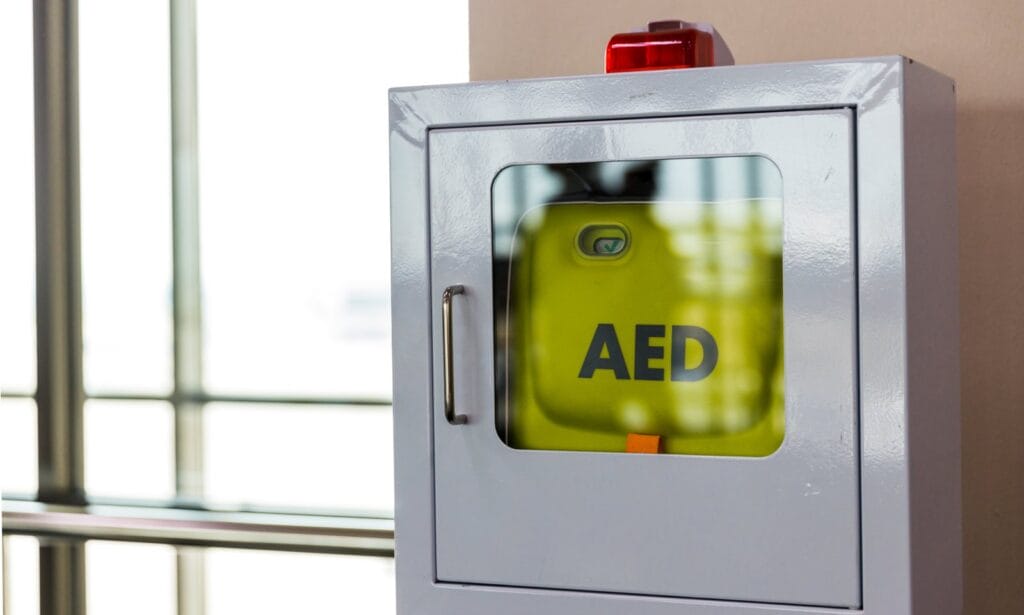
No general UK law requires a workplace to have a defibrillator. The Health and Safety (First-Aid) Regulations 1981 require employers to assess their first aid needs and provide adequate equipment, facilities and trained people. HSE guidance says that needs assessment may show an automated external defibrillator (AED) is needed. AEDs are designed for untrained members of the public to use, with spoken instructions. If you buy one, keep it accessible, signposted and maintained, and register it on The Circuit so 999 call handlers can direct people to it.
This post is for employers, office and facilities managers, and first aiders. It explains the legal position, how to decide whether your workplace needs an AED, what owning one involves, and how first aid training fits in.
What the law says
The Health and Safety (First-Aid) Regulations 1981 do not list specific pieces of equipment. They require employers to work out what first aid provision is adequate and appropriate for their workplace. HSE’s guidance on the regulations, L74, says the first aid needs assessment may identify a defibrillator as necessary.
HSE states that health and safety law does not require an AED in the workplace. If you decide to provide one, the Provision and Use of Work Equipment Regulations 1998 (PUWER) apply. HSE advises that the employer should provide information and written instructions on how to use it, such as the manufacturer’s guidance.
Schools are a useful comparison. The Department for Education has provided defibrillators to state schools in England. That was a funded programme, not a new legal duty on employers.
Our guide to EFAW, FAW and your legal duty to provide first aid at work explains how the needs assessment works in more detail.
Deciding whether your workplace needs one
Your first aid needs assessment should consider the factors that affect how quickly help can arrive and how many people could be affected. Factors that point towards having an AED include:
- Large numbers of people. Busy sites, or premises open to the public, such as shops, gyms, leisure centres and event venues.
- Distance from emergency services. Rural sites, or locations where an ambulance may take longer to arrive.
- Physical work. Strenuous tasks, or work in hot or demanding conditions.
- Spread-out sites. Large sites or multiple buildings where help may be some distance away.
- Nearby provision. Whether a registered public access AED is already close by and available at the hours you work.
Record your decision and the reasons for it in the needs assessment. Review it if your site, staffing or activities change.
Why early CPR and defibrillation matter
In a cardiac arrest, the heart stops pumping blood effectively. Early CPR and early defibrillation significantly improve the chance of survival. Every minute without help reduces that chance, so the time before the ambulance arrives makes a real difference.
AEDs are designed for anyone to use. Once the pads are attached, the machine analyses the heart rhythm and gives spoken instructions. It will only deliver a shock if one is needed. Training still helps, because it builds confidence and teaches people to combine CPR with AED use without long pauses.
Owning and maintaining an AED
Location and access
Place the AED where it can be reached quickly, ideally near the main areas of activity. Keep it signposted and make sure it is not locked away in an office that closes at 5pm. If the AED is outside, use a suitable cabinet.
Checks and maintenance
Check the AED regularly, following the manufacturer’s instructions. Most units have a status indicator that shows whether they are ready. Track the expiry dates of the pads and the battery, and replace them before they expire. Replace pads after every use.
Register it on The Circuit
The Circuit is the national defibrillator network, run by the British Heart Foundation with NHS ambulance services. Registering your AED lets 999 call handlers direct callers to it during a cardiac arrest. Registration is free, and The Circuit sends reminders to help you keep the device ready for use.
Tell people it is there
Include the AED in your first aid arrangements and staff induction. Everyone should know where it is, even if they have not been trained. Put a note of its location on first aid notices, and tell visitors and contractors about it during their site induction.
Level 3 Emergency First Aid at Work
This course trains staff to act as emergency first aiders, covering CPR, use of an AED and the main workplace emergencies. It suits lower-risk workplaces and anyone named as a first aider in your needs assessment.
Higher-risk or larger workplaces may need first aiders trained to Level 3 First Aid at Work. FAW and EFAW certificates are valid for three years.
Frequently asked questions
Is it a legal requirement to have a defibrillator at work?
No. There is no general legal requirement to have an AED at work. Employers must assess their first aid needs, and that assessment may show an AED is needed.
Can untrained people use a defibrillator?
Yes. AEDs are designed for use by untrained members of the public and give spoken instructions. Training builds confidence and helps people combine CPR with AED use.
Does first aid training cover defibrillators?
Yes. HSE notes that AED training now forms part of the syllabus for First Aid at Work and Emergency First Aid at Work courses.
What maintenance does an AED need?
Follow the manufacturer’s instructions for regular checks, and watch the status indicator. Replace pads and batteries before their expiry dates, and replace pads after any use. Registering on The Circuit gives you maintenance reminders.
This article was published in November 2026 by National Compliance Training. Regulations change, so always check the latest guidance from HSE for the current position. This article does not constitute legal advice.